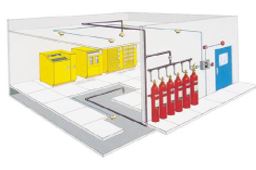
Fire suppression control panels are the core of gas extinguishing systems, managing detection, notification and discharge sequences for each FM200 Novec suppression room and other critical spaces. In data centers, server rooms, MCC rooms, archives and control rooms, our gas extinguishing control panel solutions combine cross-zoned gas suppression detection systems, early warning, countdown, hold, manual release and abort functions to protect life safety and maintain business continuity.
Matriks provides scalable architectures with products such as Detnov CCD-103 and C-TEC EP203/CON3, offering flexible automatic extinguishing panel options tailored to your project needs. Full integration with addressable fire alarm systems, field-mounted hold/release/abort stations and audible-visual warning devices ensures that each room is managed by an independent fire suppression control unit, enabling safe, traceable and standards-compliant operation of your gas fire suppression systems.
Fire suppression control panels are the main control units that manage detection, warning and gas discharge sequences in each protected room of a gas extinguishing system. In FM200, Novec 1230 and other inert gas applications for a FM200 Novec suppression room, choosing the right panel is critical for life safety, asset protection, process continuity and preventing unwanted gas discharges.
In high–risk areas such as data centers, server rooms, MCC and electrical panel rooms, archives and museums, industrial control rooms and marine engine rooms, it is a fundamental requirement according to international standards and best engineering practice to use an independent automatic extinguishing panel for each protected space.
Room–Specific Control in Gas Extinguishing Systems
In gas fire suppression projects, the control panel, detectors, manual stations and warning devices operate together to secure accurate fire detection, safe evacuation of occupants and controlled gas discharge. A professionally designed gas suppression detection and control architecture must reliably perform the following functions:
- Early and reliable fire detection (point type or aspirating detection)
- Cross-zoned logic to prevent unwanted gas discharge
- Audible and visual notification for occupants inside the protected room
- Countdown and hold functions for controlled evacuation
- Manual release and abort stations for operational control
- Integration with addressable fire alarm and building management systems
DETNOV CCD-103 – 3 Zone Fire Suppression Control Panel
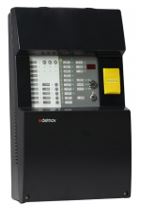
The DETNOV CCD-103 is a 3-zone conventional fire suppression control panel designed for small and medium-sized gas extinguishing system applications. It provides a robust, simple and standards-compliant solution, especially where a single room or a limited number of critical rooms need to be protected.
- 3 conventional detection zones allowing cross-zoning configurations
- 2 independent sounder outputs for two-stage alarm and release scenarios
- Configurable sounder delay via on-board PCB settings
- Dedicated release output and output for “gas released” indication
- 2 monitored inputs for discharge, pressure and flow supervision
- Built–in manual release push button on the panel front
- Separate inputs for release, abort and stop push buttons
- Configurable extinguishing activation delay (countdown time)
- Suppression modes: manual, automatic and disabled
- 2 inputs for room condition monitoring: door status and ventilation status
- Event log with up to 500 historical events
- Multi–language keypad and user interface
- Optional interface card for integration into the Detnov CAD-150 addressable loop
- Configuration software for central parameter setting
- Certified according to EN12094-1, EN54-2 and EN54-4
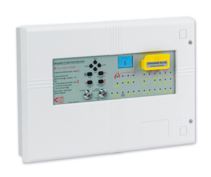
C-TEC EP203/CON3 – 3 Zone Fire Suppression Control Panel
The C-TEC EP203/CON3 is an advanced automatic extinguishing panel offering extensive engineering functions and wide programming capabilities. It allows flexible zone combinations, multi-stage scenarios and powerful integration options.
- 3 conventional detection zones
- RS-485 communication interface
- 3 independent conventional sounder outputs
- 126×64 pixel graphical LCD display
- Configurable sequence and combination of zoning for release order
- Automatic and manual key switches for access to panel functions
- Manual release push button on the front panel
- Dedicated inputs for release, abort and stop push buttons
- Extended engineering features and multiple operation options
- Delay and “hold” options for suppression activation
- Time–controlled intervention options
- Certified according to EN12094-1, EN54-2 and EN54-4
Detection Solutions in Gas Extinguishing Systems
In gas suppression detection design, the correct choice of technology is essential to avoid false alarms and to maintain business continuity. Depending on room use, ceiling height, air movement and architectural constraints, either point-type detectors or aspirating smoke detectors are selected.
Cross-Zoned Detection with Point-Type Detectors
When point-type smoke or heat detectors are used, two different detection zones are usually configured to establish a cross-zoning arrangement. Each zone has its own group of detectors, and fire suppression control panels are programmed to start the discharge sequence only when both zones are in alarm simultaneously.
- Single zone alarm: Pre-alarm – the operator is informed, but no gas discharge.
- Two-zone alarm (cross confirmation): Countdown starts and the discharge scenario is enabled.
This approach significantly reduces the risk of unnecessary discharge of gases such as FM200 or Novec 1230, minimizing operating costs and refill expenses.
Early Detection with Aspirating (Active Sampling) Systems
In rooms where business continuity and early detection are paramount – such as data centers, IT rooms, control panels and critical technical spaces – aspirating smoke detection systems are preferred.
- Continuous air sampling via pipe networks installed in the protected room
- Very early and sensitive detection at extremely low smoke concentrations
- 1st and 2nd alarm levels monitored by the fire alarm system
- 3rd and 4th alarm levels wired to the gas extinguishing system release zones
- Discrete, aesthetic detection and easy maintenance
Hold, Release and Abort Stations
Each automatic extinguishing panel is equipped with – or connected to – dedicated push buttons, typically located at the entrance of the protected room or near the panel:
- Hold Button (HOLD): When the system is in general alarm and the countdown has started, pressing and holding this button pauses the countdown, providing additional time for safe evacuation.
- Release Button (RELEASE): Allows manual gas discharge initiation, independent of detector activation, when the operator decides to manually trigger the suppression system.
- Abort Button (ABORT): When operated during the countdown period, cancels the gas discharge cycle, preventing an unwanted release.
Audible and Visual Notification Devices
In rooms protected by gas extinguishing systems, audible and visual warning devices are required to inform occupants during detection and discharge phases:
- Sounder with Flash (Sounder Beacon): Activates in the first alarm stage, informing personnel that a fire alarm has been detected in a gas-protected area.
- Bells / Additional Sounders: Indicate that the gas discharge sequence has started or that the agent is being released into the room.
These devices work in full integration with fire suppression control panels to enhance life safety.
Operating Principle of Fire Suppression Control Panels
In a typical gas extinguishing scenario, the gas suppression detection and discharge flow is as follows:
- When one detector in Zone 1 goes into alarm, the sounder with flash is activated and a pre-alarm is generated in the protected room.
- When a detector in Zone 2 also goes into alarm, the control panel starts the preprogrammed countdown (for example 30 seconds) and a second-stage alarm is activated.
- During the countdown, HOLD, RELEASE and ABORT functions are available:
- HOLD pressed and held: countdown stops; when released, countdown continues.
- ABORT activated: gas discharge sequence is cancelled.
- RELEASE activated: operator can manually trigger the gas discharge.
- If the countdown completes without intervention, the panel actuates the cylinders and discharges FM200, Novec 1230 or other extinguishing agents into the room.
At the same time, according to the fire scenario, the panel can stop ventilation and air-conditioning units, close dampers, shut down UPS systems and command other auxiliary control functions.
Integration of Fire Suppression Control Panels with Addressable Fire Systems
Each room-based gas extinguishing system controlled by an independent fire suppression control panel can be centrally monitored via the building’s addressable fire alarm system.
- At least three conditions are typically monitored for each panel: Alarm, Fault and Gas Released.
- These signals are transmitted to the main fire alarm panel via addressable monitor modules.
- From the central panel, trends, event logs and global building scenarios (elevators, evacuation messages, etc.) can be controlled and reported.
In this way, all critical spaces – including FM200/Novec suppression rooms – are monitored and controlled under a single platform, providing a simple, reliable and sustainable infrastructure for the operations team.