
How Do Beam Smoke Detectors Work? Advanced Fire Detection for High-Ceiling Spaces
-
20 November 2025
Beam smoke detector systems are advanced fire detection systems specially designed for smoke detection in high-ceiling areas such as industrial warehouses, production halls, factories, power plants, exhibition and fair venues, conference halls, atriums and food courts in shopping malls, sports halls, airports, aircraft hangars, museums and historical buildings. By constantly monitoring an invisible infrared or UV/IR light beam between the transmitter and receiver, they detect the attenuation caused by smoke particles and provide early warning, strengthening industrial fire safety where point-type detectors are insufficient.
In advanced beam smoke detectors using volumetric imaging, both UV and IR beams are analysed together to distinguish smoke from dust, significantly reducing false alarm risk. In compliance with EN 54-14, these systems offer reliable performance at ceiling heights up to 25 m (with an additional detector at mid-height when required) and can monitor wide corridors and open areas with operating ranges up to 100 m. With the ability to protect large areas using a single beam smoke detector, they deliver major advantages in cabling, installation, testing and maintenance. As a result, beam smoke detector technology has become a powerful fire detection solution preferred in modern buildings for both early detection and operational efficiency.

Fire & Safety Systems
Application Areas of Beam Smoke Detectors
Beam smoke detector systems are designed as fire detection system solutions for high-ceiling and large-volume spaces where smoke spreads over a wide area before it can be detected. Typical applications include industrial warehouses, production areas, factories, power generation facilities, exhibition and fair venues, conference halls, atriums and food courts in shopping malls, sports halls, airports, aircraft hangars, museums and historical buildings.
In such facilities, solving the problem with a large number of point-type detectors can create serious challenges and costs in terms of cabling, installation access, testing and periodic cleaning and maintenance. Beam smoke detectors, on the other hand, allow smoke detection in high-ceiling areas by monitoring large volumes over a single light beam path, providing significant advantages both in initial investment and during operation.
Operating Principle
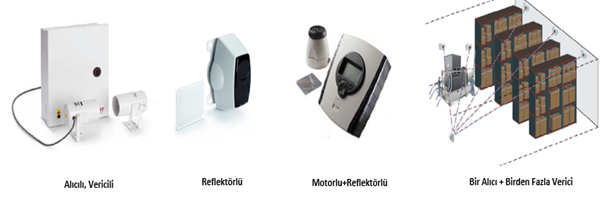
A beam smoke detector basically consists of a transmitter (emitter) and a receiver. An invisible infrared (or, in advanced types, a UV/IR) beam path is formed between these two units. Within the fire detection system, this beam path is continuously monitored and the reduction in light intensity caused by smoke passing through the beam is measured to calculate smoke density.
- The beam smoke detector is composed of a transmitter and a receiver. Its operating principle is based on the obstruction of the infrared light emitted by the transmitter and the measurement of this obstruction.
- During commissioning, the receiver takes the amount of light falling on it as a reference. In operation, it continuously compares the current light level with this reference value and calculates the percentage of beam obscuration.
- Under normal conditions, the infrared beam emitted by the transmitter reaches the receiver without any obstruction. During a fire, smoke reduces the amount of light reaching the receiver, and when the configured threshold is exceeded, the detector generates a fire alarm.
- The alarm threshold varies by manufacturer, but sensitivity can typically be set to different levels such as 12%, 25%, 35% and 50% obscuration. This enables configuration for different industrial fire safety scenarios.
- The operating distance between the transmitter and receiver varies depending on the manufacturer’s limits, but is generally in the range of 5–100 m, allowing protection of long corridors and wide open spaces with a single beam path.
- According to EN 54-14, the maximum permitted installation height is 25 m (with a second detector installed at mid-height when required).
Advanced beam smoke detectors using volumetric imaging differ from standard beam detectors in that they analyse not only IR but also UV light, providing a more detailed evaluation. This allows clear differentiation between smoke and dust and significantly reduces the risk of false alarms.
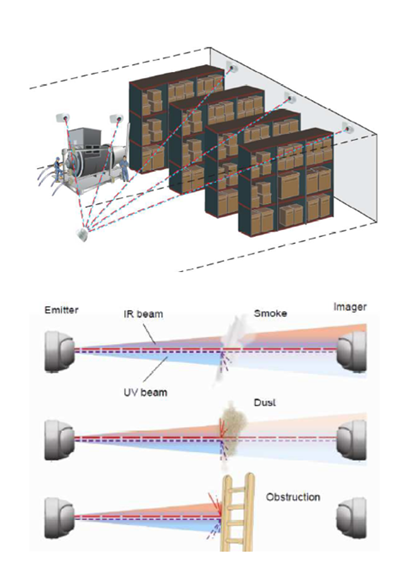
- Emitter (transmitter): an LED source that emits UV/IR light.
- Imager (receiver): a CMOS sensing circuit that focuses the collected light via a lens.
UV/IR Operating Principle:
- The UV beam is affected by both large and small particles.
- The IR beam is mainly affected by larger particles.
- If the amount of UV light reaching the receiver decreases more than the IR, it is interpreted as the presence of small particles in the air (most likely smoke) and an alarm is generated.
- If both UV and IR light levels at the receiver decrease by a similar amount, this is interpreted as the presence of large particles (most likely dust) and a fault condition is generated instead of an alarm.
- If neither UV nor IR light reaches the receiver, a fault condition is generated (for example, beam path fully blocked by a crane or similar obstacle, or transmitter failure).
In open spaces and high-ceiling volumes, the smoke effect of a fire can in theory be detected by point-type smoke detectors (up to approximately 11 m in accordance with EN 54-14). However, installing cabling for a large number of point detectors in such areas, along with their installation, access for periodic testing, cleaning and maintenance, can create significant operational constraints. Instead of using many independent point-type detectors, it is often more efficient and economical to provide protection with a single beam smoke detector.
In conclusion, beam smoke detectors have become one of the indispensable components of modern fire detection systems, especially in projects requiring smoke detection in high-ceiling areas. By offering early detection, wide coverage, fewer devices and reduced cabling requirements, they provide a rational solution for industrial fire safety and sustainable building operation.
Tags: