
Very Early Fire Detection with Aspirating High-Sensitivity Smoke Detectors
-
17 November 2025
Aspirating high-sensitivity smoke detectors are advanced fire detection systems developed for situations where conventional point or beam smoke detectors are insufficient in high-ceiling, large-volume, or heavily ventilated spaces. By providing very early fire detection and high-sensitivity smoke detection, they significantly enhance safety in critical facilities.
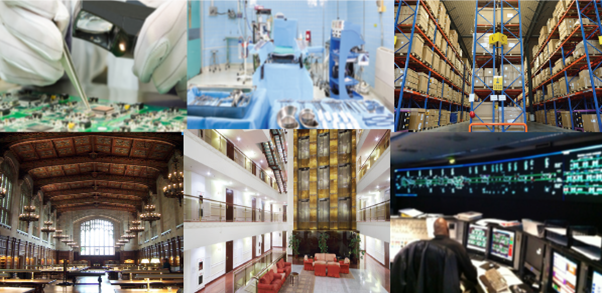
These air sampling smoke detection technologies continuously sample ambient air via a pipe network and analyze it in a sensitive detector chamber. In this way, even the smallest smoke particles can be detected in critical environments such as data centers, telecommunications facilities, industrial warehouses, production areas, atriums, museums, historic buildings, and cold storage rooms, ensuring business continuity.
Evaluated under A, B, and C sensitivity classes in accordance with EN 54-20 and NFPA standards, these systems offer advantages such as very early detection, reduced false alarm risk, wide coverage, and low maintenance costs. As a result, aspirating smoke detection systems have become a preferred advanced fire detection solution in modern facilities, especially when integrated with clean agent extinguishing systems to avoid unnecessary discharges and protect both people and high-value assets.

Fire & Safety Systems
What Are Aspirating High-Sensitivity Smoke Detectors?
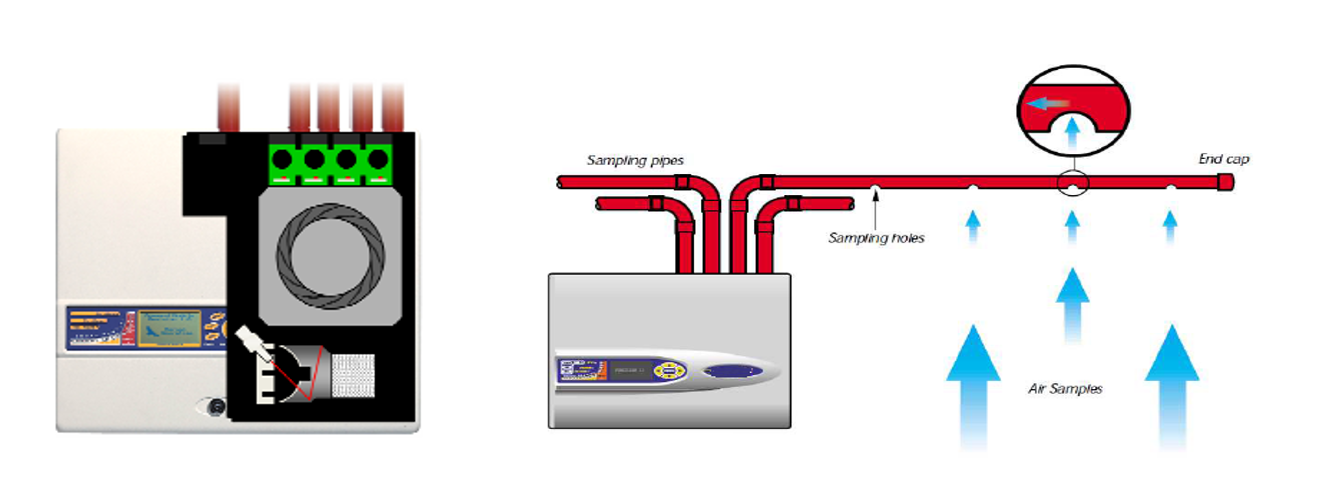
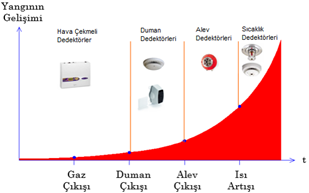
Aspirating high-sensitivity smoke detectors are systems that continuously monitor the air sampled from the protected area via a pipe network in a highly sensitive detector chamber, allowing them to detect very small amounts of smoke. In this way, they provide high-sensitivity smoke detection and very early fire detection long before conventional detectors would typically react.
Why Are They Used? (Applications and Advantages)
- Very early detection requirement in critical areas where business continuity is essential,
- Telecommunication facilities and critical communication infrastructure,
- Production plants and industrial process areas,
- Data center fire detection and computer rooms,
- Data and transaction centers where banking operations are carried out,
- Preventing unnecessary clean agent discharges when used together with gas extinguishing systems,
- Providing additional time for safe evacuation,
- Overcoming the difficulty of detecting smoke in high-ceiling and large-volume areas where smoke does not easily accumulate at the ceiling,
- Reliable air sampling smoke detection performance under challenging conditions such as dust, humidity, and strong airflows.
Detection Needs in High-Ceiling and Challenging Environments
According to the fire detection system design standard EN 54-14, the maximum permitted operating height for a point-type smoke detector is 11 meters. For beam-type smoke detectors, this limit can be increased up to 25 meters, provided an additional detector row is installed at half the ceiling height. In today’s industrial and commercial facilities, these values are frequently exceeded. In many cases, it is not practical to install detectors at half the ceiling height, and ventilation or airflows make it difficult for smoke to accumulate near the ceiling.
Therefore, in such facilities, instead of conventional point or beam detection, aspirating smoke detection systems are increasingly preferred. These systems allow the sensitivity to be adjusted according to ambient conditions, enable detection thresholds to be optimized in line with operating conditions, and provide very sensitive and very early fire detection with low service and maintenance costs.
Unlike point or beam-type detectors, aspirating detectors are “active” devices that continuously draw air samples from the environment rather than waiting for smoke to reach them. They do not require a horizontal surface (such as a ceiling) where smoke needs to accumulate, as point or beam detectors do. Thanks to this feature, they can provide multi-level detection at almost any height. They also offer a much wider sensitivity range compared to point and beam detectors. For example, a single aspirating smoke detector can be configured and used both in an ultra-clean microchip production facility and in a warehouse where diesel forklifts operate, simply by selecting the appropriate sensitivity class.
Today, aspirating smoke detectors are widely used in areas where smoke spreads over a large volume before being detected, such as industrial warehouses with stratification risk, production areas, factories, power generation plants, exhibition and fair halls, conference centers, atriums and food courts in shopping malls, sports arenas, airports, aircraft hangars, museums and historic buildings, cold storage rooms, data centers, and server rooms. They are also preferred wherever other detection methods are insufficient due to forced or natural ventilation conditions.
Operating Principle
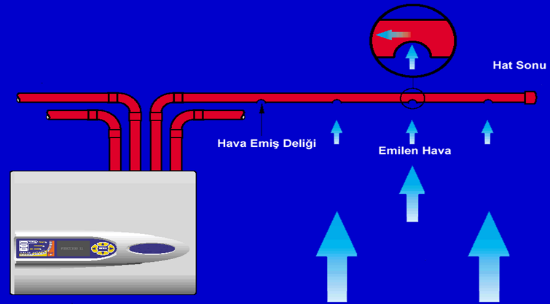
In the area to be monitored, sampling pipes are installed horizontally or vertically according to a defined design layout, and one end of each pipe is connected to the detector unit.
Sampling holes are drilled in these pipes at suitable positions determined using design guidelines and, where applicable, manufacturer design software. The detector uses its internal aspirator/fan to continuously draw air through these sampling points.
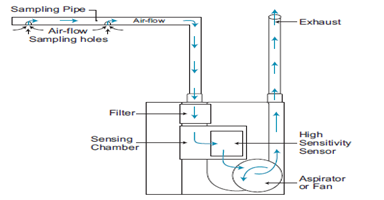
As soon as the air from each pipe enters the device, its flow rate is measured by sensors. If the flow rate is higher than expected, this may indicate a crack or break in the pipe network; if it is lower, this may indicate a blockage. In this way, both smoke detection and continuous monitoring of pipe integrity are achieved.
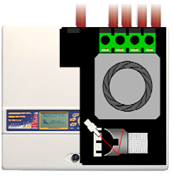
After this flow measurement, the sampled air passes through a filter that removes larger particles and then reaches the detector chamber.
In the detector chamber, the air is scanned by a laser beam. If there are no smoke particles in the air, the beam is absorbed on the chamber wall. If smoke particles are present, the light is scattered by the particles, and this scattered light is collected by a concave reflector and focused onto a photosensitive cell. The cell converts the light into an electrical signal, which is then used to generate an alarm according to the set thresholds, enabling very early fire detection.
In this way, reliable detection can be achieved at very low smoke concentrations using aspirating smoke detection systems.
When designing aspirating systems, keeping sampling pipes as short as possible, minimizing changes of direction, and using as many sampling pipes as practically feasible are key factors that help reduce transport time and improve detection performance.
In accordance with the relevant standards, the maximum transfer time for air to travel from the last sampling hole on any pipe to the detector must not exceed 120 seconds. Sampling hole layouts can be based on standard point detector spacing. If different layouts are required depending on environmental conditions (such as vertical detection or in-cabinet applications), the design should be adapted accordingly.
The air sampling speed depends on the number and size of sampling holes, the number of bends in the pipework, external air pressure, pipe length and the aspirator speed of the device. When determining sampling hole locations and pipe routes, manufacturers’ design software can be used. These tools allow designers to simulate and calculate hole positions, pipe lengths, pipe routing, and hole diameters in order to optimize system performance.
Standards
European Standards
- EN 54-20 Fire Detection and Fire Alarm Systems – Part 20: Aspirating Smoke Detectors (EN 54-20);
| Class | Description | Example Application(s) | Requirements |
|---|---|---|---|
| A | Very High Sensitivity | Areas where very diluted smoke may occur or where very early detection is required (e.g. environmentally controlled areas where diluted smoke may leak into air-conditioning ducts). | TF2A, TF3A, TF4, TF5A |
| B | High Sensitivity | Areas where early detection is required (e.g. IT and electronic equipment cabinets). | TF2B, TF3B, TF4, TF5B |
| C | Normal Sensitivity | General areas where standard detection is sufficient (e.g. normal rooms where the sensitivity of point or beam detectors is adequate). | TF2, TF3, TF4, TF5 |
According to EN 54-20, the aspirating smoke detector standard, systems are divided into three classes.
These are:
- Class A: Very High Sensitivity – Areas where very diluted smoke may occur or where very early detection is required.
- Class B: High Sensitivity – Areas where early detection is required.
- Class C: Normal Sensitivity – General areas where the sensitivity of point or beam-type detectors is sufficient.
American Standards
- National Fire Alarm and Signaling Code (NFPA 72)
- Standard for the Protection of Information Technology Equipment (NFPA 75)
- Standard for the Fire Protection of Telecommunications Facilities (NFPA 76)
| System | Alarm Sensitivity (per sampling hole) | Alarm Sensitivity (per sampling hole) | Sampling Point Coverage Area | Transport Time |
|---|---|---|---|---|
| Very Early Warning (Class A) | 0.2% obs/ft | 1.0% obs/ft | 200 ft² (18.6 m²) | < 60 s |
| Early Warning (Class B) | N/A | 1.5% obs/ft | 400 ft² (37.2 m²) | < 90 s |
| Normal Detection (Class C) | N/A | Equivalent to standard smoke detector sensitivity | 900 ft² (83.6 m²) | < 120 s |
According to NFPA 72 and NFPA 76, the aspirating smoke detector standard also defines three system classes.
These are:
- Class A: Very High Sensitivity – Areas where very diluted smoke may occur or where very early detection is required. (60 seconds)
- Class B: High Sensitivity – Areas where early detection is required. (90 seconds)
-
Class C: Normal Sensitivity – General areas where the sensitivity of point or beam-type detectors is sufficient. (120 seconds)
Tags: