
Emergency Control and Monitoring Functions in Fire Detection and Alarm Systems
-
20 November 2025
In modern buildings, the fire detection and alarm system does far more than simply detect fire; through the fire alarm control panel it manages all critical safety components such as sprinklers, gas extinguishing, smoke extraction, pressurization and emergency scenarios, becoming the central control point of building fire safety.
According to the 2015 “Regulation on the Protection of Buildings from Fire” in Türkiye, these systems must perform integrated detection, alarm, control and communication functions and provide critical automation for safe evacuation and operational continuity. This integrated approach reduces risk and ensures that all systems respond quickly and correctly in the event of a fire.

Fire & Safety Systems
Role of Fire Detection and Alarm Systems
Fire detection and alarm systems are designed by taking into account the development stages of fire; to provide sufficient time for the safe evacuation of occupants, to issue warnings within the prescribed times, to inform facility managers so that evacuation decisions can be made, and, where required by the process, to support business continuity and property protection. In this context, controlled shutdown of the process, activation of extinguishing systems, and automatic execution of smoke control and pressurization scenarios are all part of the emergency control system functions.
Today, the fire detection and alarm system is no longer limited to simple detection and siren activation. In line with the development of buildings and technology, it is obliged to operate in active integration with other building systems. According to the 2015 Turkish “Regulation on the Protection of Buildings from Fire”, Fire Detection and Alarm Systems are defined as a complete system that combines detection, alarm, control and communication functions under a single structure (Part Five: Electrical Installations and Systems, Section Four: Fire Detection and Alarm Systems). Therefore, the fire alarm control panel has become the central “brain” for all fire safety subsystems in the building.
In this article, the monitoring and control functions associated with the fire alarm control panel, as described in the regulation, are summarized under the headings of sprinkler systems, gas extinguishing systems, smoke control and pressurization systems and emergency control systems.
Sprinkler Systems and Fire Alarm Panel Integration
Article 78 – Sprinkler system alarm stations
If a sprinkler system and an automatic fire detection and alarm system are installed in a building, the sprinkler system alarm stations and flow switches shall be connected to the fire alarm control panel. Alarm signals coming from the sprinkler system shall be monitored either on a separate regional monitoring panel or on the fire control panel by creating separate regional alarm indicators within the scope of the sprinkler monitoring system. The shut-off valves’ supervisory switches and other fault contacts related to the sprinkler system shall also be continuously monitored by the fire alarm system in the same manner.

The fire detection and alarm system continuously monitors, in the pump room or on the sprinkler piping in the field, signals from devices such as:
- Electric fire pump fault, run, reverse phase (mains failure) status,
- Diesel fire pump fault, run, fuel level status,
- Jockey pump fault status,
- Fire water storage tank level status,
- Wet/dry alarm valve pressure switch low-pressure status,
- Post indicator valve open–closed status,
- Shut-off valve open–closed status,
- Flow switch “flow present” status,
and similar critical points within the scope of the sprinkler monitoring system, enabling early detection of possible faults and hydraulic problems.
Gas Extinguishing Systems and Alarm Integration Functions
Article 79 – Gas extinguishing system alarm and fault outputs
If a gas extinguishing system is installed in a building and a fire detection and alarm system is present, the alarm and fault outputs of the extinguishing system shall be connected to the fire alarm control panel and monitored via separate regional indicators.

Where automatic or manually operated gas, dry chemical powder or similar extinguishing systems are installed in a building or structure, it is required that their activation shall be automatically detected by the fire detection and alarm system. To ensure this, the fault, alarm and discharge status contacts of the extinguishing systems are connected as monitoring inputs to the fire alarm control panel. In this way, critical information such as gas discharge, fault condition or out-of-service status can be centrally monitored by both the technical team and facility management.
Smoke Control and Pressurization Systems
Article 80 – Control and monitoring of smoke control and pressurization systems
If a smoke control and pressurization system is installed in a building, the fault and status-change signals of these systems shall be monitored and controlled on a separate regional monitoring panel or on the fire control panel by creating separate regional status and fault indicators. Manual controls of smoke control and pressurization systems may be carried out from a dedicated control panel or combined with the above-mentioned monitoring panels and implemented within the fire detection and alarm system.
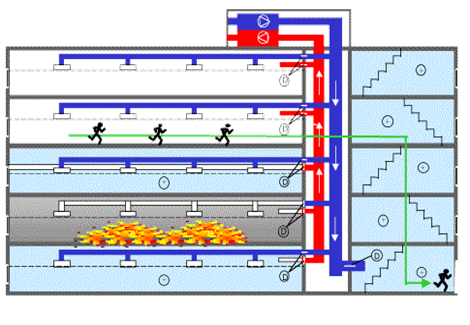
The smoke control and pressurization system is designed, as part of the fire-fighting strategy, to enable occupants to evacuate the building safely and without panic, without exposing them to harmful smoke. The fire detection and alarm system sends start or stop commands to the relevant systems in line with the smoke control scenario and ensures that “run/fault” information of these systems is continuously monitored via the fire alarm control panel.

- Stairwell pressurization fans
- Smoke exhaust fans
- Smoke vent windows
- Motorized smoke/fire dampers
- Ventilation systems
- Air-handling and air-conditioning units
- Fresh air supply and exhaust fans
- Motorized dampers

According to Article 60 of the 2015 “Regulation on the Protection of Buildings from Fire” in Türkiye, if a car park is classified as enclosed and its total area exceeds 2000 m², a mechanical ventilation system is mandatory.
In such cases, the fire detection and alarm system, in line with the car park smoke scenario, performs control and monitoring functions: on a zone basis for jet-fan systems, and on a device basis for smoke exhaust fans and dampers. In this way, both smoke extraction and user safety in car parks are managed centrally via the fire alarm control panel.
Emergency Control Systems and Fire Scenarios
Article 82 – Emergency Control Systems
(1) The emergency control system, which must automatically perform the required control functions in case of fire, shall have the following features:
a) Releasing the electromagnetic door holders and similar devices that keep fire doors and other closures, which must be closed during a fire, in their normally open position,
b) Bringing into operation the pressurization devices of stairwells and elevator shafts,
c) Ensuring that smoke control systems perform their functions,
d) Unlocking doors and turnstiles that are kept locked for security or similar reasons,
e) Depending on design characteristics, preventing the use of elevators during fire, or enabling their use for evacuation purposes by the fire brigade or trained building fire-response teams,
f) Automatically transmitting fire notification to the local fire brigade and, where required, to the electricity utility, municipality, police or gendarmerie, the facility director, building owner and other designated recipients,
and shall be capable of performing these functions.
(2) Emergency control system operations are carried out by control units that form part of the hardware and software integrity of the fire detection and alarm system. Any control and command functions that may be performed by the controlled systems and devices themselves, as well as by related security systems or building automation systems, must in no way prevent or interfere with emergency control operations initiated via the fire alarm control panel during a fire or similar emergency.
Tags: